The rebound that took hold in Canada's economy over the spring is now at risk, economists warned on Monday, after the United States imposed 50% tariffs on roughly $28 billion of Canadian goods following the failure of last week's negotiations. The list, which includes cement, honey, alcohol, textiles, machinery and electronics, covers about 5% of what Canada sells to its southern neighbour.
Trevor Tombe of the University of Calgary put the direct hit at around 50,000 jobs in the affected industries, with another 35,000 potentially touched through supply chains, while stressing that both numbers carry wide error bands. The pain will be concentrated in British Columbia, then Ontario and Quebec, and will arrive over months rather than all at once.
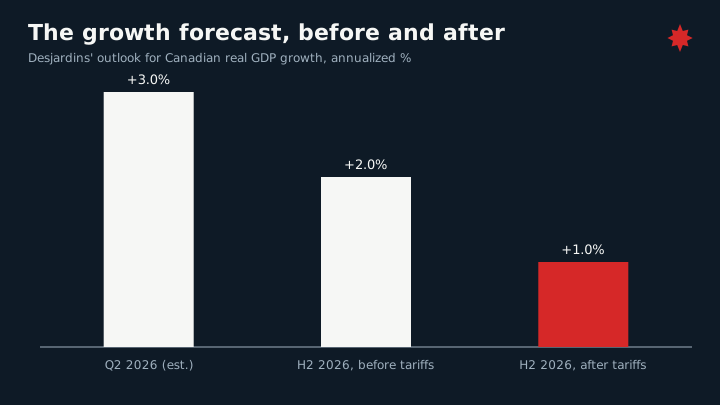
Most forecasters still expect the country as a whole to avoid a recession. Randall Bartlett, Desjardins' deputy chief economist, said the second quarter likely grew close to 3% annualized, but the tariffs and the uncertainty around them should cut growth over the remainder of the year to about 1%, half of his previous 2% call, with a further drag of a few tenths of a point into 2027.
Growth has slowed for Canada largely because of uncertainty rather than tariffs — and that uncertainty has just ratcheted back up.
Capital Economics was more pessimistic, arguing the new duties push Canada closer to a downturn, especially if the U.S. responds to Ottawa's retaliation with more of its own. President Trump has already floated 50% tariffs on autos and parts from January 2027. By Capital's estimate, the average duty on a Canadian good crossing the border has almost doubled to 5.6% from 2.9%, eroding the relative advantage Canada had enjoyed over other exporters.
Two variables will determine the final damage. The first is the central bank, which was widely expected to hold at 2.25% next week and, in Bartlett's view, will stay there through year-end rather than react to a shock whose shape is still unclear; Canadian counter-tariffs could even prove stagflationary if firms raise prices as sales fall. The second is fiscal support. Finance Minister François-Philippe Champagne pledged help for affected workers and businesses for as long as needed, and Ottawa has room to act thanks to energy-boosted revenues — room that many smaller provinces lack.